By Mandy Kanaulu
Massage Therapy Student at Kapiʻolani Community College and Administrative Assistant at Seven Senses Spa
What are pain patterns?
For massage therapists, pain patterns refer to the predictable ways discomfort may be experienced or felt throughout the body based on the relationship between muscles, connective tissues, joints, movement patterns, and the nervous system. These patterns help therapists develop a treatment approach by recognizing common relationships between muscles, movement, and discomfort. Because pain patterns are commonly observed across a wide range of clientele, they can also provide therapists with insight into everyday habits, movement patterns, and physical demands that may contribute to common areas of pain or discomfort.
An example would be a massage therapist assessing a client's gait, or walking pattern. The way a person moves can provide valuable insight into movement patterns that may be contributing to their discomfort. For instance, a limp may place extra stress on the lower back, feet that consistently turn outward while walking can contribute to hip or knee discomfort, and habitually carrying a purse, backpack, or child on the same side may lead to uneven tension in the shoulders and neck. The human body is remarkably adaptable and often compensates for imbalances to keep us moving. However, when those compensations persist over time, they can contribute to pain and dysfunction in seemingly unrelated areas.
Why does this matter?
This matters because it allows massage therapists to better treat whatever ailment a client has. An example is the familiar experience of a “stiff neck”. Many massage therapists will encounter clients who wake up with sudden neck discomfort, limited range of motion, and the feeling that their neck is “stuck” in a certain position.
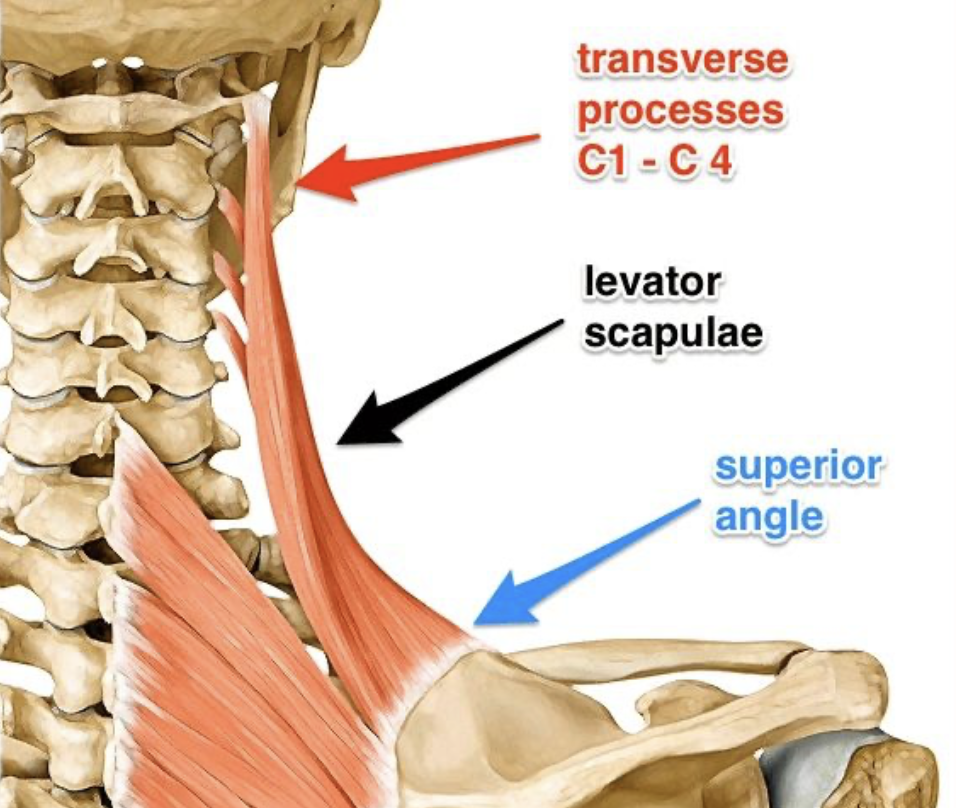
Contrary to common belief, the area where pain is felt is not always the location of the structure contributing to the discomfort. One muscle frequently involved in these neck and shoulder pain patterns is the levator scapulae. Although it is often associated with neck tension, the levator scapulae is technically classified as a shoulder muscle because of its attachment to the scapula.
The levator scapulae originates at the transverse processes of the first four cervical vertebrae (C1–C4) and inserts along the medial border of the scapula near the superior angle. In simpler terms, this muscle connects the upper neck to the inner portion of the shoulder blade.
Its primary function is to elevate the scapula, such as during a shoulder shrug, and assist with downward rotation of the shoulder blade. However, when the scapula is stabilized, the levator scapulae can also contribute to movements of the neck, including side bending and rotation toward the same side.
Because this muscle connects the cervical spine to the shoulder blade, tension or sensitivity within the levator scapulae can contribute to discomfort that is often perceived as neck stiffness, even though the muscle itself is technically part of the shoulder region.
What are some other common examples?
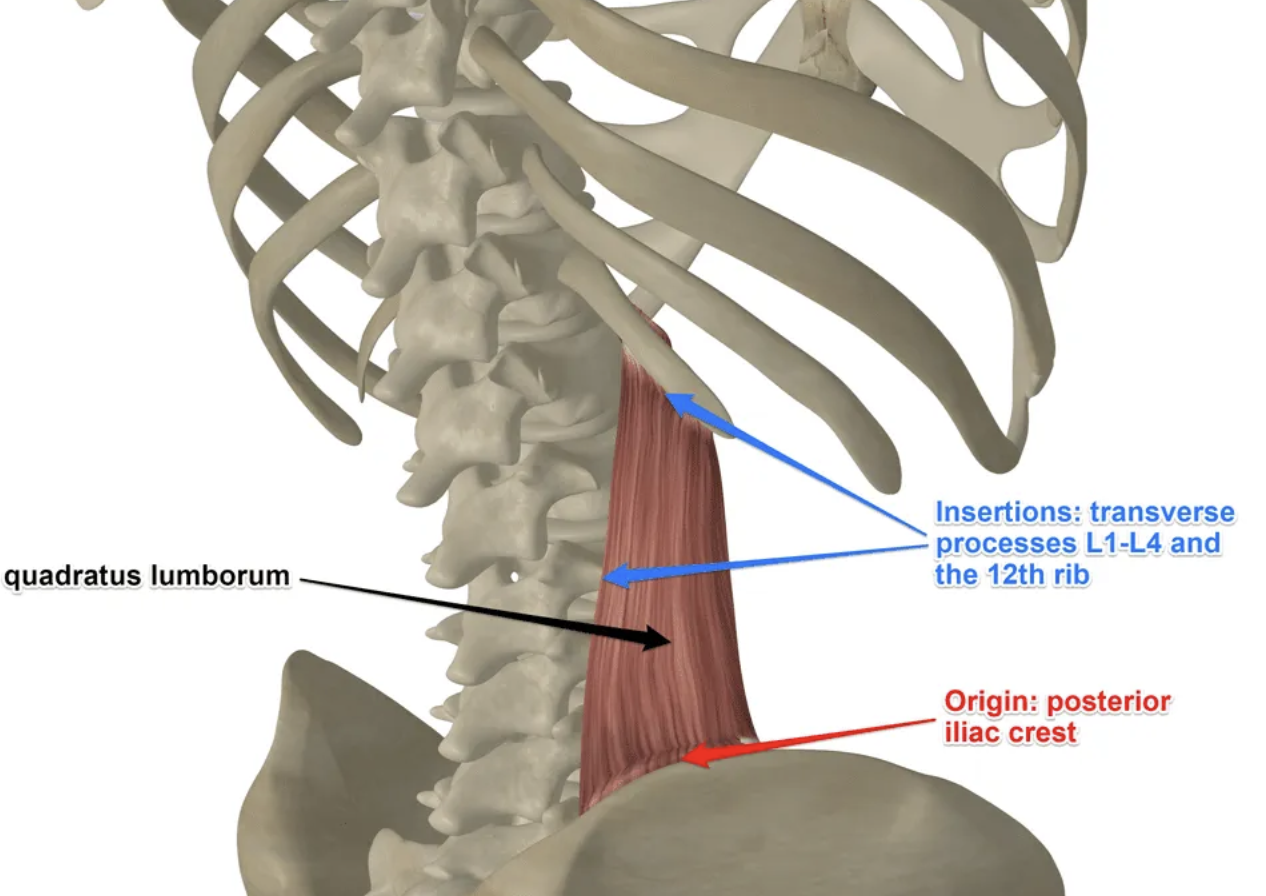
Another example would be the quadratus lumborum, or more commonly known as the QL. Located deep within the lower back, this muscle plays an important role in stabilizing the spine and connecting the pelvis to the rib cage. Because of its ability to elevate one side of the pelvis, the QL is often referred to as the “hip hiking” muscle.” This action helps maintain balance during activities such as walking and standing.
The QL originates from the posterior iliac crest and iliolumbar ligament and inserts onto the transverse processes of the lumbar vertebrae (L1–L4) and the 12th rib. In simpler terms, this muscle connects the lower portion of the pelvis to the lower spine and bottom rib. It assists with side bending of the spine, stabilizing the lumbar region, and maintaining control between the pelvis and spine during movement.
Because of its role in posture and movement, the QL may become overworked when the body relies on it to compensate for changes in mechanics. For example, an individual with a limp caused by injury, weakness, or limited mobility may develop an uneven walking pattern. This can require one side of the QL to work harder to stabilize the pelvis and maintain balance, which may contribute to increased tension, fatigue, or discomfort in the lower back.
Understanding the QL highlights why looking beyond the location of pain is important. Lower back discomfort is not always influenced by the lower back alone—it can be connected to the way the entire body moves, compensates, and adapts to daily demands.
Other common pain patterns…
While the muscular system is vast and there are much more issues that I can could list, some common muscles that people tend to have issues with are:
Piriformis:
A small muscle located deep beneath the gluteus maximus that helps stabilize and rotate the hip. Some individuals with pain, tingling, or numbness traveling down the back of the leg (commonly referred to as sciatica) may have irritation involving the piriformis. While the sciatic nerve usually passes beneath the muscle, anatomical variations exist where part or all of the nerve passes through it. If the piriformis becomes irritated or tight, it may contribute to sciatic nerve symptoms, a condition often referred to as piriformis syndrome. During an acute flare-up, direct pressure over the muscle may be too uncomfortable, so a massage therapist may instead work on the surrounding muscles and tissues while staying within their scope of practice.
Pectoralis Minor
A thin muscle located beneath the pectoralis major that originates from the third, fourth, and fifth ribs and inserts onto the coracoid process of the scapula. Its primary function is to stabilize the shoulder blade by drawing it forward and downward. Because many people spend long hours sitting, driving, or using computers and mobile devices, the pectoralis minor can become shortened, contributing to rounded shoulders, restricted overhead movement, and increased tension in the neck and upper back. Understanding the role of the pectoralis minor helps explain why discomfort between the shoulder blades or in the neck may sometimes be influenced by a muscle located on the front of the chest.
The pectoralis minor is an important muscle to consider, especially when working with clients experiencing shoulder or neck discomfort. While treating the area where pain is felt can often provide relief, the body functions as an interconnected system. Although working on the neck and shoulders may help reduce discomfort, addressing tension in the pectoralis minor can help the chest open and allow the shoulders to rest in a more natural position rather than being pulled forward. This may reduce unnecessary strain on the muscles of the neck and upper back that can contribute to discomfort.
As tension in the pectoralis minor decreases, the shoulder blade is able to move more freely, improving overall shoulder mechanics and mobility. This muscle is an excellent example of how the muscles on the front (anterior) and back (posterior) of the body work together to influence posture and movement. Understanding these relationships allows massage therapists to look beyond where pain is felt and appreciate how different muscle groups work together rather than treating them in isolation.
Occipitofrontalis (epicranius)
The occipitofrontalis is a scalp muscle made up of two parts: the frontalis (forehead) and occipitalis (back of the head), which are connected by the galea aponeurotica, a sheet of connective tissue covering the skull. These two muscles work together as a functional unit, allowing movement and tension to be distributed across the scalp. Because they are connected, increased tension or restriction in one muscle can affect the other. For example, tightness in the occipitalis may create increased pull through the galea, causing the frontalis to compensate by increasing activity, and vice versa.
This imbalance may contribute to sensations of scalp tightness, forehead pressure, and tension patterns that can be associated with headaches, especially when combined with tension in the neck and suboccipital muscles. The occipitofrontalis demonstrates how muscles do not work in isolation—compensations in one area can create tension patterns throughout the connected system.
That was a lot of information… so what does it actually mean for you as a client?
Not everyone is fascinated by anatomy, movement, or the science behind pain—and that's perfectly okay. However, having a basic understanding of how the body works can help you recognize that it functions as one interconnected system. The way we move, sit, stand, or repeat certain activities each day can contribute to tension and discomfort in areas that may seem unrelated.
One reason I wanted to share this information is because many people wonder why a massage therapist may spend time working on an area that isn't where they feel pain. As a client, this can sometimes feel confusing or even leave you feeling unheard when your primary concern is one area, but your therapist is focusing elsewhere. The reason is that pain isn't always caused by the tissue that hurts. Because the body is interconnected, tension in one muscle or region can create discomfort somewhere else. Massage therapists assess how the body moves and feels, using their knowledge of anatomy, movement, and palpation skills to identify restrictions that may be contributing to your symptoms. As those areas begin to release, clients often notice relief in the area where they originally felt pain.
That said, massage therapy is a collaborative process. Never hesitate to ask your therapist why they are working on a particular area or how it relates to your symptoms. Remember, your therapist isn't offended by feedback—they welcome it. If something isn't helping, if you'd like more or less pressure, or if you're still feeling discomfort in a particular area, speaking up allows your therapist to adapt the treatment to your needs. Your input helps guide the treatment and allows them to adjust their approach to better meet your needs.
Overall, simply becoming more aware of your posture, movement patterns, and daily habits can go a long way toward preventing or reducing pain. Massage therapy is an effective tool for relieving tension and restoring balance, but lasting improvement also depends on the habits you practice outside the treatment room. When massage is paired with body awareness and healthy movement, the results are often more effective and longer lasting.
So far, my studies have given me a much deeper appreciation for the incredible way our bodies function. The more we understand how our bodies move, adapt, and compensate, the better equipped we are to care for them in the long run. Massage therapy isn't magic—it's anatomy, biomechanics, and pain science working together to help the body function at its best.